

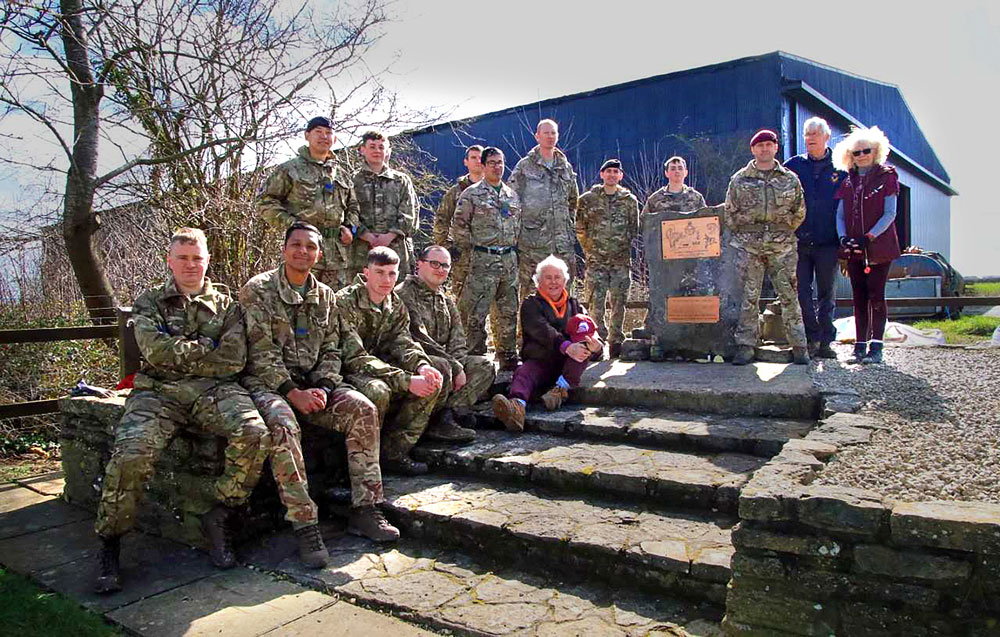
Soldiers from the Royal School of Signals at Blandford Forum have helped to improve a poignant Dorset memorial at the nearby former Tarrant Rushton airfield that played an important and secret role in the Second World War.
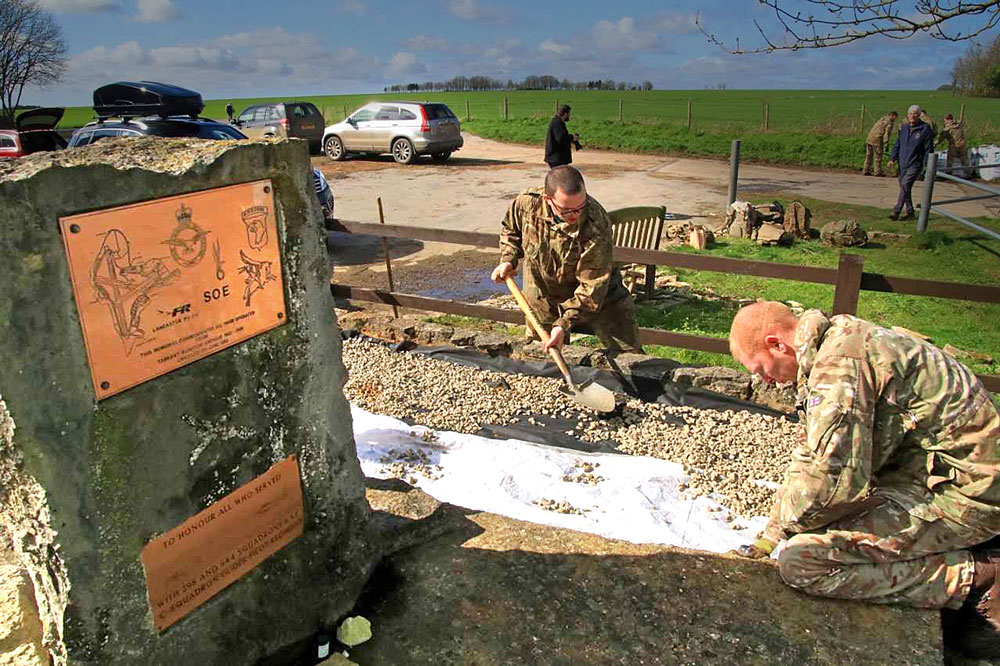
On the Tarrant valley to Witchampton road at Windy Corner, near Hogstock, the stone memorial will be 40 this summer, after being unveiled on June 6, 1982 – the 38th anniversary of D-Day, 1944 – as the last of the airfield was being demolished.
The help from the Jerboa Troop of the 11th Signal Regiment’s 4 (Military Training) Squadron came as
the small, dedicated team of
volunteers who help maintain the stone memorial appeal for more volunteers and donations to carry on their work.
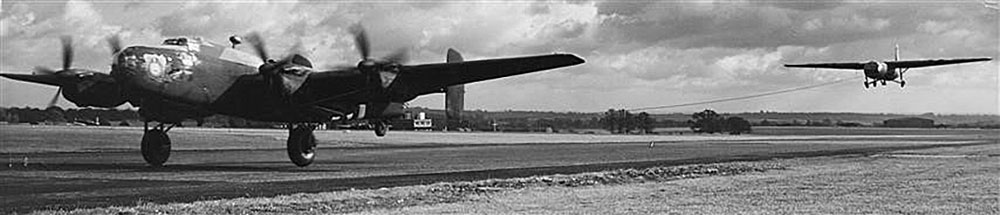
Brave young RAF aircrews flew dangerous low-flying missions in Halifax bombers deep into occupied Europe during 1944 and 1945 – dropping secret agents, SAS troops, arms and equipment to the Resistance forces.
Tarrant Rushton’s Halifax squadrons also played an important role in the crucial D-Day, Arnhem and Rhine Crossing invasions of France, the Netherlands and Germany that saw the bombers tow wooden troop-carrying Horsa and tank-carrying Hamilcar gliders.
A previous generation of soldiers flew in the gliders of those crucial operations as they operated radios to ensure communication between the many military elements of the invasion.
Ten members of the Jerboa Troop of the 11th Signal Regiment’s 4 (Military Training) Squadron spent a morning at the memorial digging out the old gravel topping before laying a weed-proof plastic membrane and laying three tonnes of limestone chippings from the Suttle stone quarry at Worth Matravers.
Bob Seymour – the son of an RAF navigator who flew dangerous missions in 1944 – is one of the dedicated volunteers who maintains the stone memorial by the former entrance gate.
Bob said: “I brought my father back to Tarrant Rushton before he died aged in his 90s and he was very moved to see the memorial.
“The soldiers from the Royal School of Signals tackled their task with military organisation and lots of enthusiasm. It was great to meet them and chat about the history of Tarrant Rushton and its importance which should never be forgotten.
“We are very grateful to the soldiers for giving their time so willingly and enthusiastically,” added Bob.
John Nicholson, of the memorial group, explained: “The airfield was home to
3,000 men and women in the Second World War.
“Built by the Wimpey construction company in just seven months at a cost of £1m – more than £40m in today’s money – RAF Tarrant Rushton opened in May 1943, and was home to two squadrons 298 and 644, which flew the large Halifax four-engined bomber.
“The airfield was built to train crews in the dangerous towing of wooden troop-carrying Horsa and tank-carrying Hamilcar gliders not just for the ‘D-Day’ invasion of France, but also the invasion of Arnhem in 1944, and the crossing of the Rhine into Germany in March 1945.
“Young crews also flew dangerous low-level flights to drop secret agents from the Special Operations Executive (S.O.E.) into Occupied Europe – from the south of France to the Low Countries and up to Norway – to disrupt German military activities and help Resistance fighters,” added John who lives in Wimborne.
After the RAF left in 1946, the following year saw the pioneering aviation research and manufacturing company Flight Refuelling move in – a tenant that would remain at the airfield for more than 30 years, until 1980 when the 300-acre site was closed.
The airfield’s 300 buildings were demolished in 1981 with three large concrete runways broken up for hardcore material that was used in the building of the Wimborne bypass.
Donations to the memorial fund can be made at gofundme.com/f/tarrant-rushton-memorial-restoration. To volunteer to help maintain and improve the memorial, contact John Nicholson at jn7vmn@gmail.com or call 07905 346643.
by Lorraine Gibson





Leave a Reply