

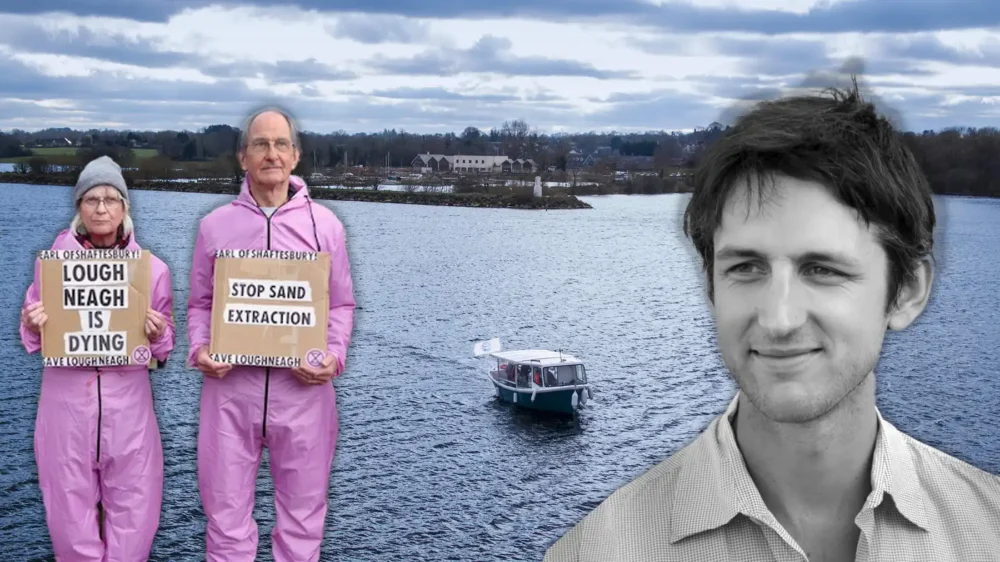
A ROW over algae and pollution in Northern Ireland has brought protests to a Dorset village.
Lough Neagh, the largest lake in the UK and Ireland at some 19 miles long and nine miles wide, is visited by thousands each year.
But more than just a beautiful and substantial natural landmark, the lake has a very important role – including providing more than 40% of Northern Ireland’s drinking water and being home to numerous species.
In recent years, however, the lake has been plagued by a blue-green algae and pollution that have prompted protests over the impact on biodiversity.
Wildfowl numbers have plummeted, according to monitors, with locals, including many of the few remaining fishing crews on Lough Neagh, putting the blame squarely on management of the lake.
Though management of the lake is through the Lough Neagh Partnership Ltd – a group made up of elected representatives, landowners, fishers, sand traders and more – the lake is ‘owned’ by the 12th Earl of Shaftesbury, Nicholas Ashley-Cooper.
The family has claimed the lough’s bed, banks and soil since the 19th century, after being handed the asset by the Chichester family.

Lough Neagh. Picture: Courtesy of Tourism Northern Ireland
Which is why, on Monday (March 18), members of environmental campaign group Extinction Rebellion gathered at the gates of St Giles House, the Earl’s seat, in the village of Wimborne St Giles.
The St Patrick’s Day demonstration was aimed at raising awareness of the problems at Lough Neagh and protesting what campaigners called the Earl of Shaftesbury’s “exploitation” of the lake.
“Lough Neagh is suffering an ecological catastrophe. Urgent action is needed,” said Joanna Bury, environmental activist and author from nearby Wimborne Minster.
“The Lough faces a further severe challenge, namely sand extraction licensed by the Earl of Shaftesbury.
“1.5 million tons of sand is dredged from the bed of the Lough every year. This causes environmental damage and likely exacerbates the ill effects of algal blooms, causing dead zones for fish.”
Dr Chris Hackney, of Newcastle University, carried out a survey of the depth of the Lough Neagh bed and found sand dredging alone has created scars of up to 56 feet deep (17 metres) in places.
And last week, a cross-section of environmental protesters demanded urgent action outside Stormont in Belfast.
“The Earl of Shaftesbury must stop allowing sand extraction, and he must take action to reverse the damage done to the Lough,” Joanna added.
“He is uniquely positioned to help with its recovery. Ideally it should be properly managed in public ownership but the Earl has not ruled out a private sale.”
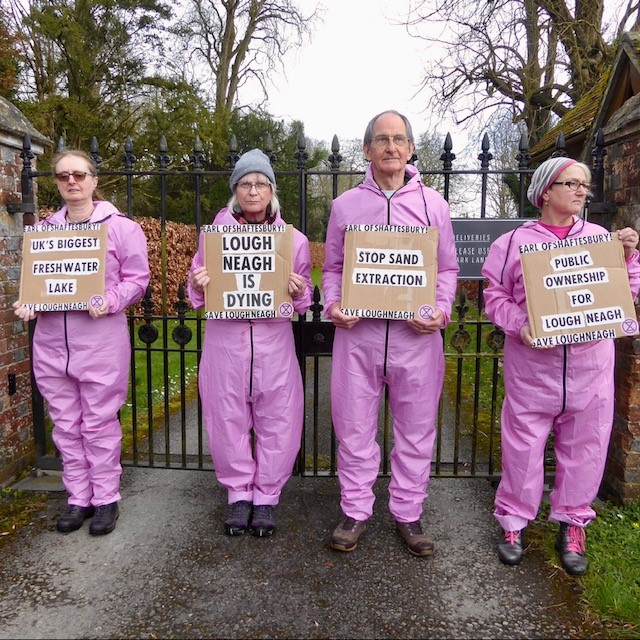
XR Wimborne protestors at the gates of St Giles House
In February, the Earl met with NI environment and rural affairs minister Andrew Muir to discuss concerns around Lough Neagh and the algae blooms.
After that gathering, the Earl said: “I expressed my firm commitment to collaborate with his team and other Lough Neagh stakeholders to find a comprehensive, long-term solution.
“The discussion provided a valuable platform to address these critical matters.
“What was discussed aligns with my previous statements and sentiments that underscored the imperative for a coordinated, cross-departmental approach to tackle the environmental issues linked to Lough Neagh.
“The algae bloom in 2023 highlighted the severe risks to human and animal health, emphasising the pressing need for a centrally-managed government body with the authority to regulate activities impacting the lough’s health and protection.
“Additionally, my position on the ownership of the lough bed and soil remains the same since I assumed responsibility for The Shaftesbury Estate of Lough Neagh Ltd in 2005.
“I am open to exploring options for future ownership as part of our ongoing efforts to ensure a secure and sustainable future for Lough Neagh.”
A Department of Agriculture, Environment and Rural Affairs (DAERA) in Northern Ireland spokesperson said: “The situation in Lough Neagh is extremely concerning, the Minister shares the worries of many across Northern Ireland. Minister Muir is determined to provide the leadership needed to address the issues in Northern Ireland’s waterways but has been clear we need collective action and investment across government, private and public sector and in the community.
“The Minister is working at pace with officials on actions needed informed by science and evidence. Conscious this is a problem which has built up over decades where no quick fixes exist, long term difficult decisions will be needed from many, to turn things around.

DAERA Minister Andrew Muir has described the situation as “extremely concerning”
“The starting point for Lough Neagh is the Environment Strategy and Northern Ireland’s first Environmental Improvement Plan (EIP). The blue green algae issue, most notably seen in Lough Neagh but also across various other water bodies in Northern Ireland, cannot be seen in isolation from the natural environment more generally and we cannot tackle its problems in isolation either.
“The EIP, which is a plan for significantly improving our natural environment, will contain actions, setting direction of travel for the coming decades, relevant to improving water quality, including at Lough Neagh. The Minister intends to bring the draft EIP to his Executive colleagues later this month.
“Once the EIP has received Executive agreement, a further and more specific Lough Neagh paper developed by the joint DAERA / DfI Water Quality Steering Group, will be presented shortly thereafter to a subsequent Executive meeting.
“The Minister has been clear since he took up the role just over a month ago and visited Lough Neagh, that the scenes witnessed in 2023 are likely to reappear this year, indeed a number of reports of blue green algae blooms have already been received thus far.
“Acknowledging this, the Department is currently leading on the production of an Inter-Agency Monitoring Protocol should we experience similar blue-green algae issues in the 2024 season. This will provide guidance for councils and water-based businesses on how to consider blue-green algae risks.”







Leave a Reply